

Find your routing logs
From the left navigation, click Inbound, then Routing Logs. This is the first page you land on inside Inbound.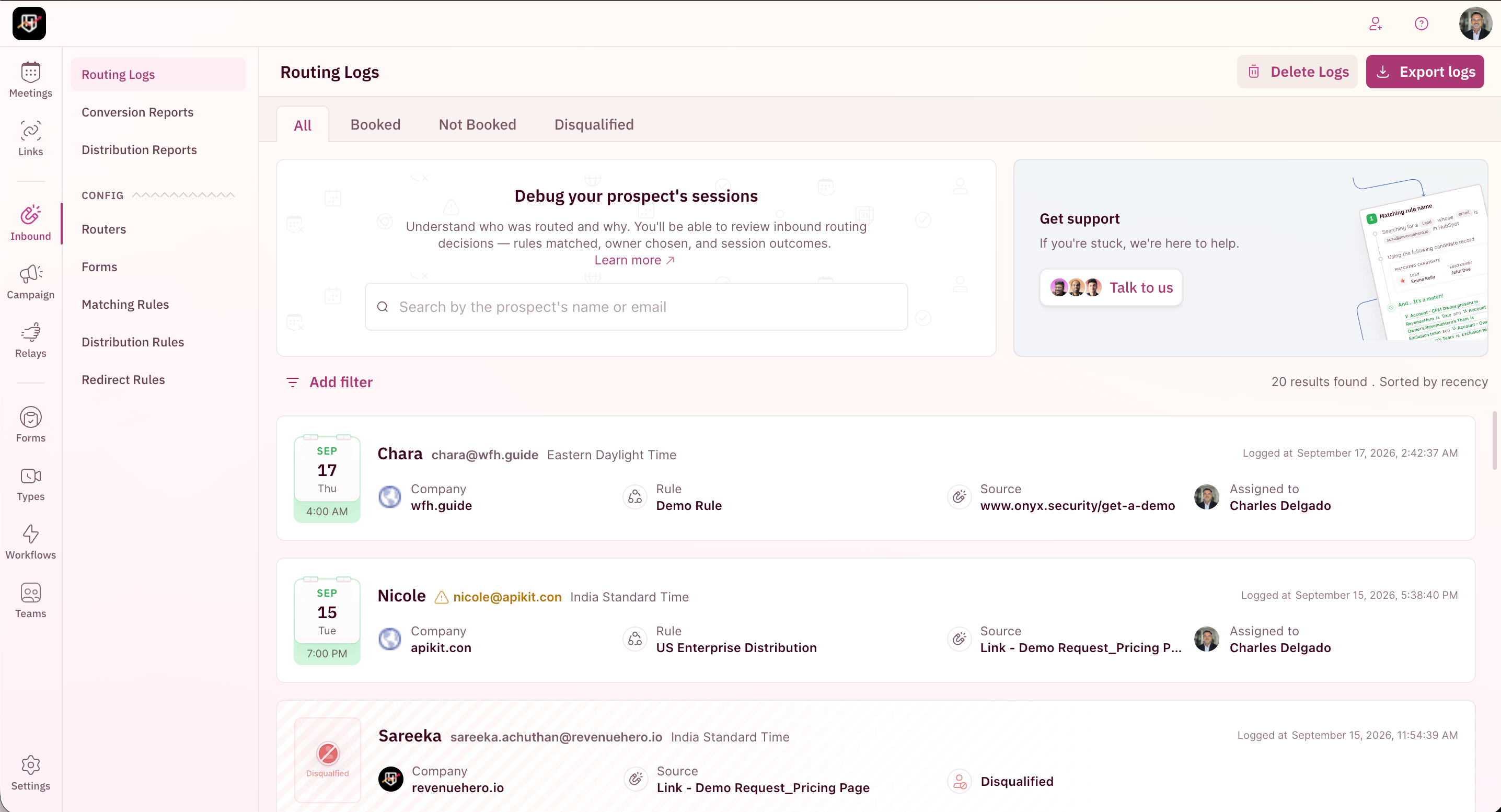
The routing logs list
Each row is one submission, showing the prospect, their company, the rule that assigned the meeting, the source page or link, who it was assigned to, and when it was logged. Every submission ends in one of three outcomes:- Booked - the prospect picked a slot and a meeting was created.
- Not Booked - the prospect qualified and saw the scheduler, but left without booking.
- Disqualified a disqualification rule stopped the submission before a meeting was offered.
Open a log
Click any row to open that submission’s journey. The view has three parts that stay in sync: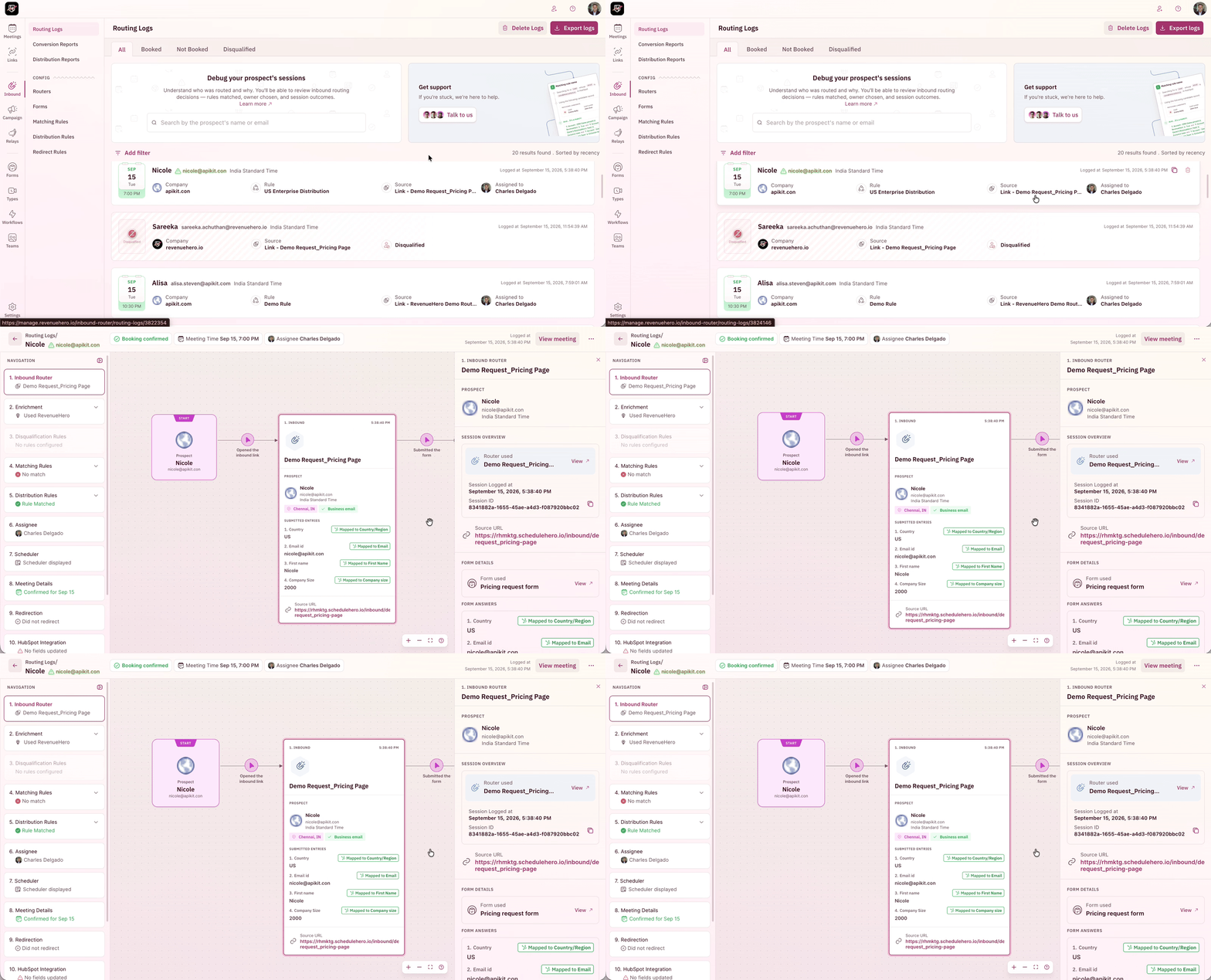
- The step index (left) lists every stage this submission passed through, with a status dot. Click a step to jump to it.
- The flowchart (center) draws the path as connected cards, so you can follow the submission from the form to the booked meeting. Pan to move around.
- The details panel (right) shows everything about the step you selected, from the submitted form fields to the exact rule that matched.
What you’ll see in each log
The steps you see depend on what happened to that submission. A booked meeting shows the full path; a disqualified one stops early.- Inbound Router - the router that caught the form, the source page or link, the form used, and the prospect’s submitted entries.
- Enrichment - any data RevenueHero added about the prospect and their company before routing, such as company size or industry.
- Disqualification Rules - whether disqualification ran, and if the prospect was disqualified, which rule caught them. If none apply, it reads “not active”.
- Matching Rules - which matching rule was checked and whether it Passed, Failed, or was Not Checked, plus how it matched, for example “Prospect email matches Contact - Email”.
- Distribution Rules - which distribution rule was used when there was no CRM match, and the round robin style it applied (Strict or Flexible).
- Assignee - the rep who got the meeting, the round robin queue at that moment, and the suggested assignee.
- Scheduler - whether the scheduler was displayed to the prospect, the time slots they saw and what they did next.
- Meeting Details - for a booking: the time, duration, and a link to view the meeting. For a no-book: “Prospect did not select a slot and left the scheduler”.
- Redistribution - if the prospect did not book, whether they were redistributed and to which new owner.
- CRM, Calendar, and Conferencing - the downstream writes: whether the owner was updated in your CRM or retained, the calendar event created, and the meeting link generated.
How teams use routing logs
Routing Logs is an admin tool. Today only admins can open it, so it is usually your RevOps lead or ops-minded managers who live here. Here is how it’s typically used:- Answer “why did this prospect go there?” - open that prospect’s log, read the journey, and reply with the exact rule and owner, often pasting the log link straight into Slack.
- Find and fix drop-offs - filter to Not Booked to see who qualified but did not book, then check whether redistribution picked them up.
- Audit a rule or a rep - filter by Rule to confirm a new rule is firing, or by Meeting owner or Team to review what a person or team received.
- Build custom reports - filter to the slice you want, then Export logs for a CSV in your inbox.
Troubleshoot common issues
A lead went to the wrong rep
A lead went to the wrong rep
Read the Matching and Distribution steps. Matching sends known prospects to their existing owner, so a surprise owner usually means a matching rule fired. If it came through distribution, check the rule and the Assignee step.
A prospect did not book
A prospect did not book
Check the Scheduler and Meeting Details steps. “Prospect did not book a meeting” means they qualified but did not pick a slot. Look at Redistribution to see who is now following up.
Someone was disqualified unexpectedly
Someone was disqualified unexpectedly
Open the Disqualification step to see which rule caught them, then adjust that rule. Prospects can also be disqualified if they don’t match any of your (matching/distribution) rules. Consider adding a catch all rule to prevent these instances if you find that the prospect is actually valid.
The owner did not update in the CRM
The owner did not update in the CRM
Read the CRM step. It states whether the owner was updated or the existing owner was retained, which tells you if the behavior was by design.
Not sure why a rule matched
Not sure why a rule matched
Expand the rule’s conditions (Passed / Failed) or use Compare with a rule.
Good to know
- Logs are sorted by recency, so the newest submissions are at the top.
- The steps shown vary by submission. Calendar and conferencing steps appear only when a meeting was booked; redistribution appears only when the prospect did not book.
- Routing Logs answer “what happened to this one submission”. For the funnel across all submissions, use Conversion Reports.
Conversion Reports
The funnel across every submission.
Matching Rules
How known prospects reach their owner.
Distribution Rules
How round robin assigns new leads.
Round Robin History
The queue and who is up next.