A team is how you tell RevenueHero “these are the people who can receive meetings.” Every distribution rule points to a team, but how meetings get assigned within that team is flexible. You can round-robin across all members, route to a subset of selected members based on conditions, or assign to a single rep for a specific territory or product line. The team is the container; the distribution rule is the logic. ₹
BEFORE YOU BEGIN
  1. Invite your reps to RevenueHero so they appear as selectable members
  2. Each rep should connect their calendar before being added to a team. Without a connected calendar, RevenueHero can’t check their availability or create meetings on their calendar.

How teams work

When a prospect submits a form and reaches your scheduler, RevenueHero evaluates your distribution rules to determine who should get the meeting. Each distribution rule points to a team and specifies how to assign within it:
  • All members: Round-robin across everyone in the team. The simplest setup.
  • Selected members: Pick specific reps from the team for this rule. You can create multiple distribution rules pointing to the same team, each routing to different members based on conditions like company size, region, or product interest.
  • Single member: Select one rep. Useful when a specific territory or product line belongs to one person (e.g., all DACH leads go to Frank, or all CLM product inquiries go to Sahana).
Beyond assignment, teams also control:
  • Availability: The team’s working hours define when prospects can book. This is especially important for multi-region setups where US reps should only show availability during US hours and EU reps during EU hours.
  • Groups: Sub-groups within a team for collective round-robin (e.g., pair an AE with an SE on every call so the prospect meets both).
  • Roles: Each member has a role (Admin, Manager, or Member) that controls what they can edit within the team.

Create a team

Step 1: Open the Teams page

Click Teams in the left sidebar. This shows all existing teams in your account with member count, group count, timezone, and member avatars.
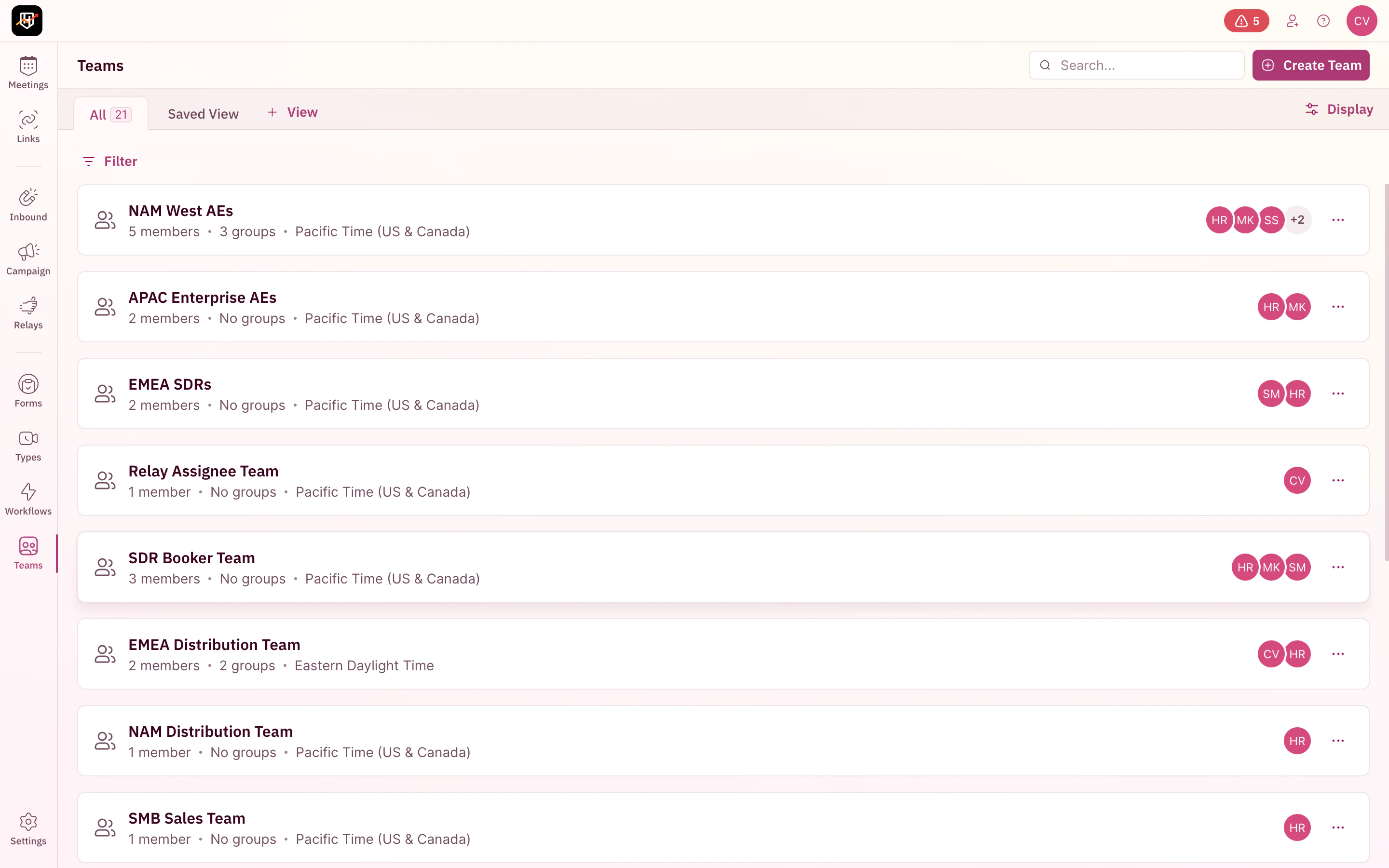
Click Create Team in the top-right corner.

Step 2: Select members

The wizard opens with the question: “Who has to be part of this team?” Search by name or scroll the list and check each member you want to add.
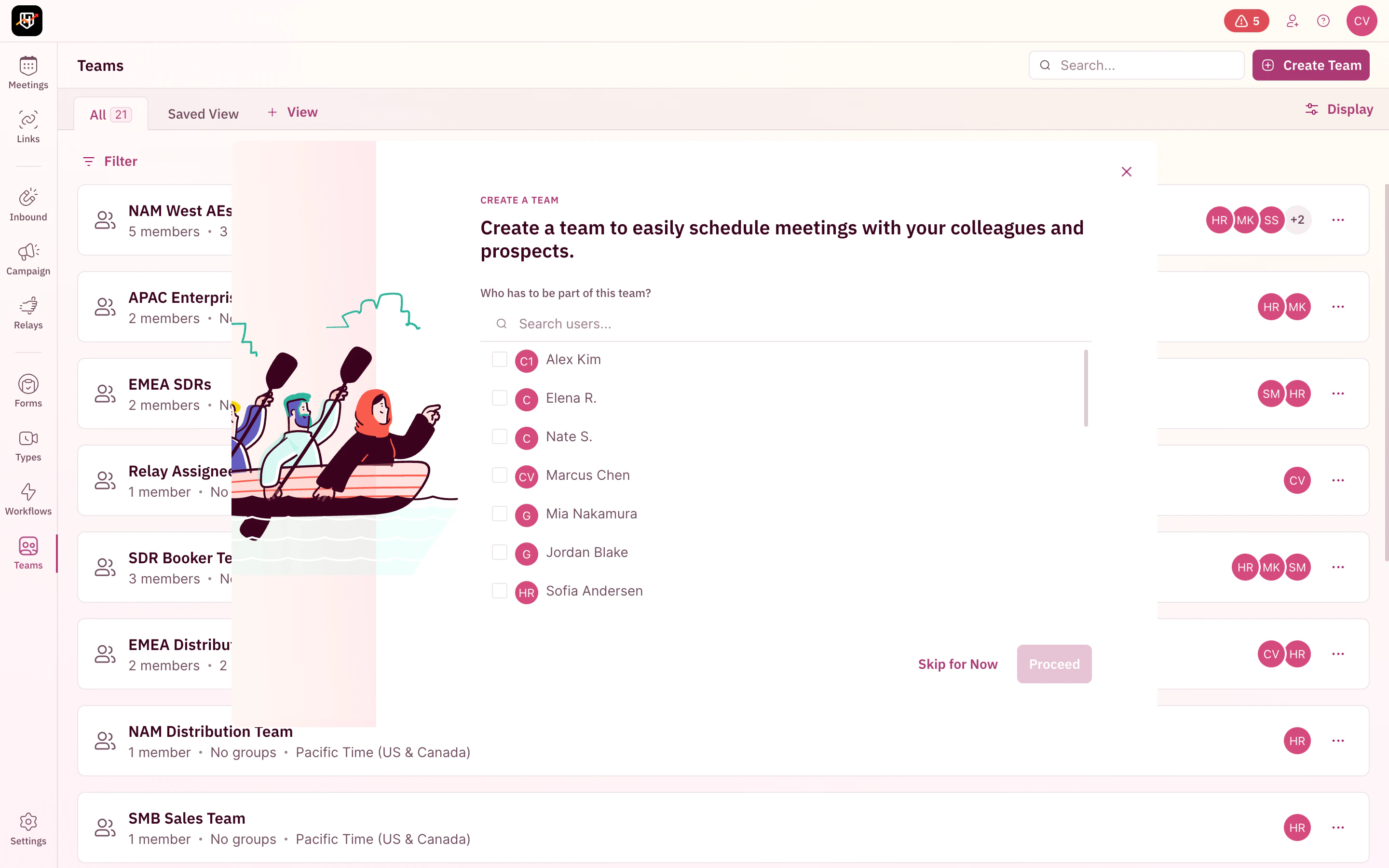
You can add members now or click Skip for Now to add them later from the team detail page. Click Proceed to continue.
A rep must have their calendar connected before they can receive meetings through round-robin. Adding a rep without a connected calendar means they’ll appear in the team but won’t get any bookings. This is a common onboarding miss that surfaces as “why isn’t this rep getting meetings?” Make sure every rep connects their calendar and conference tool before you go live.
Only add reps who should actually receive meetings from this team. A common mistake is adding yourself (the admin) to a sales team during setup, then wondering why you’re getting routed demo calls.

Step 3: Set the team’s availability

Choose when this team can receive meetings. You have three options:
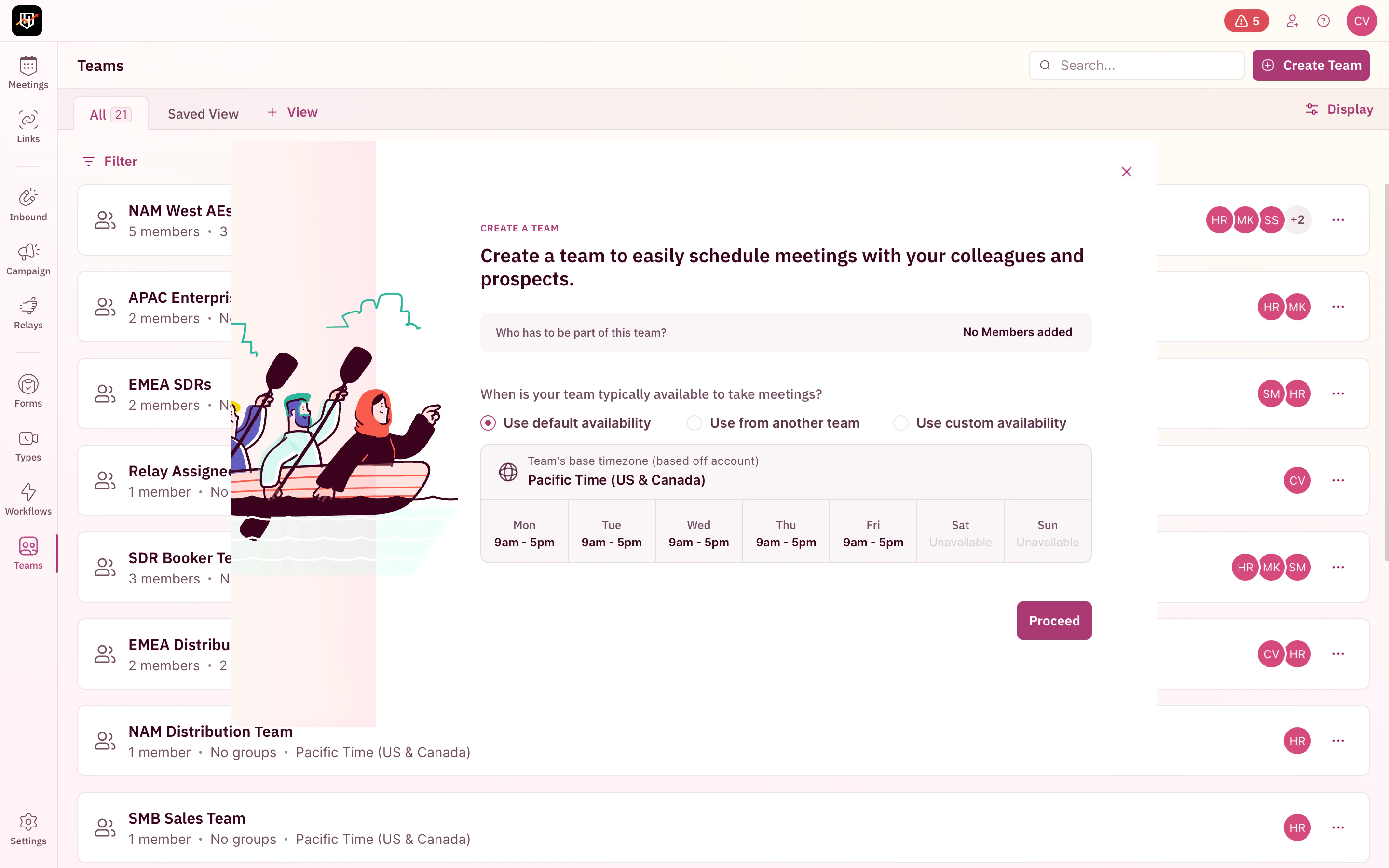
OptionWhen to use
Use default availabilityStandard Mon-Fri, 9am-5pm in your account’s timezone. Works for most teams.
Use from another teamCopy availability from an existing team. Useful when creating a second team in the same region.
Use custom availabilitySet specific days and time slots. Use this for teams in different timezones or with non-standard hours.
The timezone shown is your account’s base timezone. You can change the team’s timezone later from the team settings.
If you have reps across regions, create separate teams with region-appropriate availability. For example, your EU reps might work 9am-5pm CET, but if they’re on a US-facing team, set their custom availability to match the overlap window (e.g., 2pm-10pm CET / 8am-4pm ET). This prevents prospects from seeing irrelevant time slots outside their business hours.
Click Proceed to create your team.

The team detail page

Once your team is created, you land on the team detail page. This is your central view for managing the team.
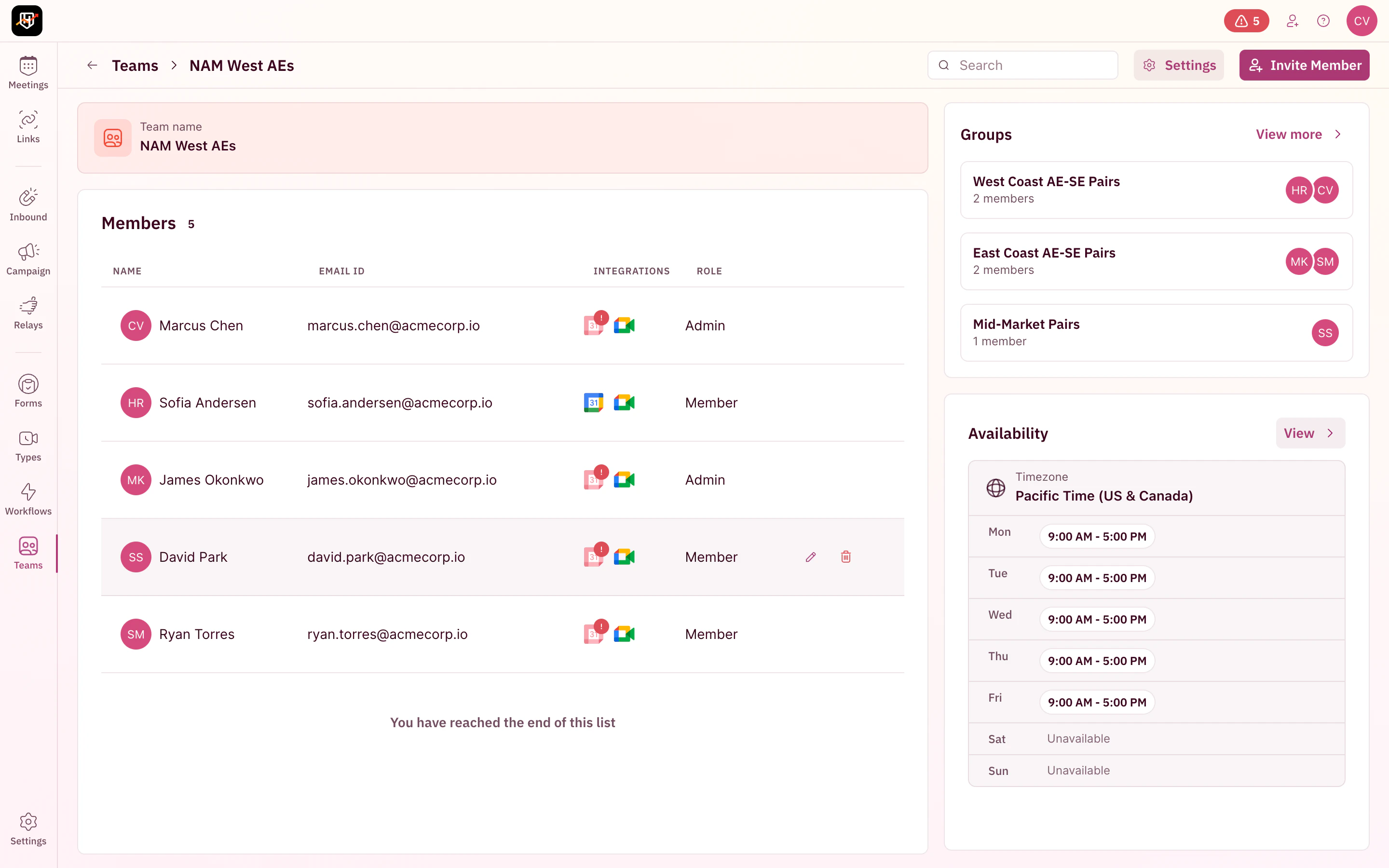
The page has three sections:
  • Members (left): All reps on this team with their email, calendar integration status, and role (Admin, Manager, Member). Hover over a member to see edit and remove actions.
  • Groups (top right): Sub-groups for collective round-robin pairings (e.g., AE + SE pairs). Click View more to manage groups.
  • Availability (bottom right): The team’s working hours grid. Click View to edit.
From here you can:
  • Click Invite Member to add new reps
  • Click Settings to rename the team or change its timezone
  • Create groups for collective round-robin setups

How teams connect to routing

Teams become active when you reference them in your routing setup. The full chain looks like this:
  1. Create a team (this article) to define who can receive meetings
  2. Create a distribution rule that points to this team and specifies the assignment logic (all members, selected members, or single rep) and any conditions (company size, region, product)
  3. Attach the distribution rule to an inbound router, campaign router, or relay
You can create multiple distribution rules that point to the same team, each with different conditions and different selected members. For example, with one “Sales” team of 10 reps:
  • Rule 1: Leads with fewer than 500 employees go to Evan (single selected member)
  • Rule 2: Leads with 500 or more employees round-robin among the other 9 AEs (selected members)
  • Rule 3: Fallback rule round-robins across all 10 members
This is how you build territory or segment-based routing without creating dozens of teams. The team stays simple; the distribution rules handle the logic.
You can also use the same team across multiple distribution rules, routers, and relays. Your “NAM AEs” team might be referenced by your inbound router’s distribution rule, your campaign router, and your relay’s distribution pod. The round-robin queue is shared across all of them.

One team or many?

This is the first structural decision you’ll make. There’s no universal answer, but here’s how customers typically approach it:
ScenarioRecommended structureWhy
5 AEs, all US, same working hoursOne team: “US AEs”Simple. One distribution rule handles everything.
AEs in US + AEs in EMEATwo teams: “NAM AEs” and “EMEA AEs”Different availability windows per region. Prevents prospects from seeing 3am time slots.
AEs split by segment (Enterprise vs Commercial) across regionsFour teams: “US Enterprise”, “US Commercial”, “EMEA Enterprise”, “EMEA Commercial”Region x segment matrix gives you clean routing and accurate availability per group.
SDRs who hand off to AEs via relayTwo teams: “SDRs” (relay bookers) and “AEs” (relay assignees)Relays need separate teams for the booker and assignee side.
One AE owns a specific territoryOne team, but use a distribution rule with a condition that routes to that single selected memberYou don’t need a separate team for one person. Put them on the main team and use distribution rule conditions.
AE + SE on every callOne team with groups: create an “AE-SE Pairs” group using collective round-robinGroups within a team handle multi-rep meetings without needing separate teams.
Resist the urge to create a separate team for every distribution rule condition. If 10 reps are on the same schedule and in the same region, they belong on one team. Use distribution rule conditions and selected members to control who gets what. Creating too many small teams makes round-robin queues shallow and team management harder.

Your team is ready. Next, create a distribution rule to define how meetings get assigned to the reps on this team. 🎉🎉🎉

Add Members to a Team

Add or invite new reps to an existing team.

Create a Distribution Rule

Set up round-robin to assign meetings to your team.

My Availability

Individual reps can customize their personal availability within the team schedule.

Remove Members from a Team

Safely remove reps from a team with rule reassignment.